Our Story
By Sarah Begovac

The idea for Scholē IRL unofficially started the summer of 2025, when my friend and collaborator of this pod, Ira Allen, and I were trying to think through this idea of scholē together, an ancient Greek term that translates to “leisure” or the intentional slow work of learning, thinking, and studying on behalf of some collective discovery of human flourishing. A term that resonated with me, as someone who has been both inside and outside of academia (I was Ira’s former grad student at Northern Arizona University) trying to find the time and space to develop my thinking outside of a traditional intellectual commons, and with Ira, a tenured professor at NAU trying to salvage what of scholē is left within the university ecosystems. We quickly came to the realization that any practice of scholē is 1) traditionally associated (hoarded) within academic institutions and is 2) becoming less available both inside and outside of university ecosystems that are, well, collapsing as we know it.
We wanted to know how can we salvage a sense of scholē, or thinking for the sake of thinking, learning something because you want to learn something, and studying as a means for being together and understanding the world for people inside, outside, and alongside the university. The practice of scholē itself invites us to engage in a means-ends dialectic that challenges capitalistic productivity and neoliberal policies that determine education as a means for professional or instrumental ends.
We found ourselves reaching out to people in the undercommons of para-academia - to thinkers, educators, activists, and community organizers who are making space for scholē outside the conventional university infrastructures for people to think together. Our podcast traces their stories, how they made or are making space for study, what community means within these spaces, and what the future of learning might entail. Season 1 has guests all over the Global North making new possibilities for learning and thinking together.
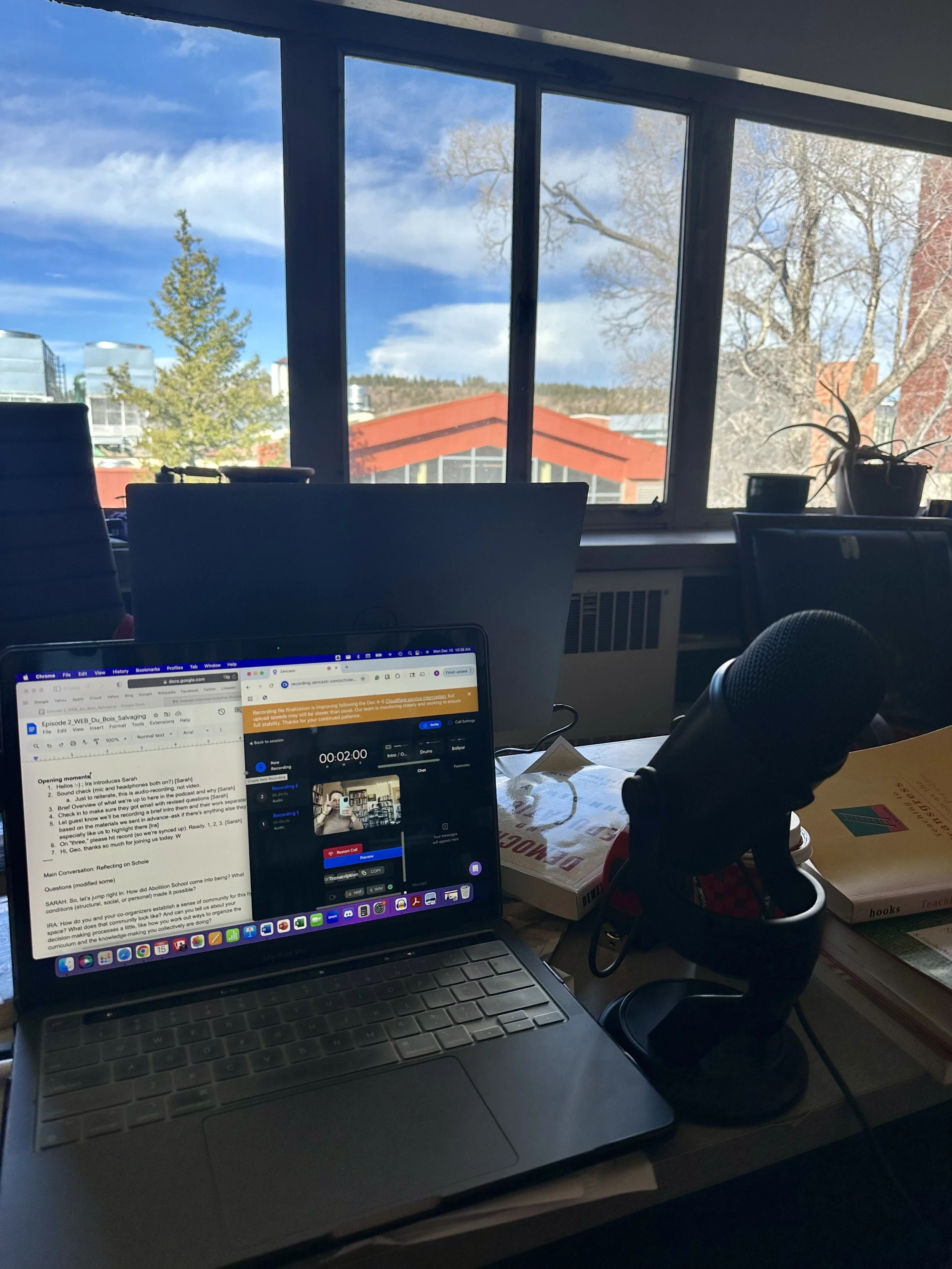
Resources that inspired us:
Allen, Ira J. 2024. Panic Now? Tools for Humanizing. Knoxville, TN: University of Tennessee Press.
Aristotle. 2019. Nicomachean Ethics. Edited and Translated by Terence Irwin. 3rd ed. Indianapolis: Hackett Publishing.
Aristotle. 2013. Politics. Edited and Translated by Carnes Lord. Chicago: University of Chicago Press.
Davis, Diane. 2010. Inessential Solidarity: Rhetoric and Foreigner Relations. Pittsburgh: University of Pittsburgh Press.
Harney, Stefano, and Fred Moten. 2013. The Undercommons: Fugitive Planning & Black Study. New York: Minor Compositions.
Mailloux, Steven. 2017. Rhetoric’s Pragmatism: Essays in Rhetorical Hermeneutics. Penn State University Press.
Mifsud, Mari Lee. 2015. Rhetoric and the Gift: Ancient Rhetorical Theory and Contemporary Communication. Duquesne University Press.
Miller, Susan. 2007. Trust in Texts: A Different History of Rhetoric. Carbondale: Southern Illinois University Press.
Samons, Loren J. 2004. What’s Wrong with Democracy? From Athenian Practice to American Worship. Berkeley: University of California Press.
Sharp-Hoskins, Kellie. 2023. Rhetoric in Debt. University Park, PA: Penn State University Press.
Vivian, Bradford. 2023. Campus Misinformation: The Real Threat to Free Speech in American Higher Education. Oxford: Oxford University Press.
Williams, James H. 2015. “A Brief History of International Education Policy: From Bretton-Woods to the Paris Declaration.” In Globalization, International Education Policy and Local Policy Formation: Voices from the Developing World. Ed. Carolyn A. Brown. Springer Dordrecht: 9-23.
Withers, Deborah, and Alex Wardrop. “Reclaiming What Has Been Devastated.” The Para-Academic Handbook: A Toolkit for Making-Learning-Creating-Acting, edited by Alex Wardrop and Deborah Withers, HammerOn Press, 2014.